
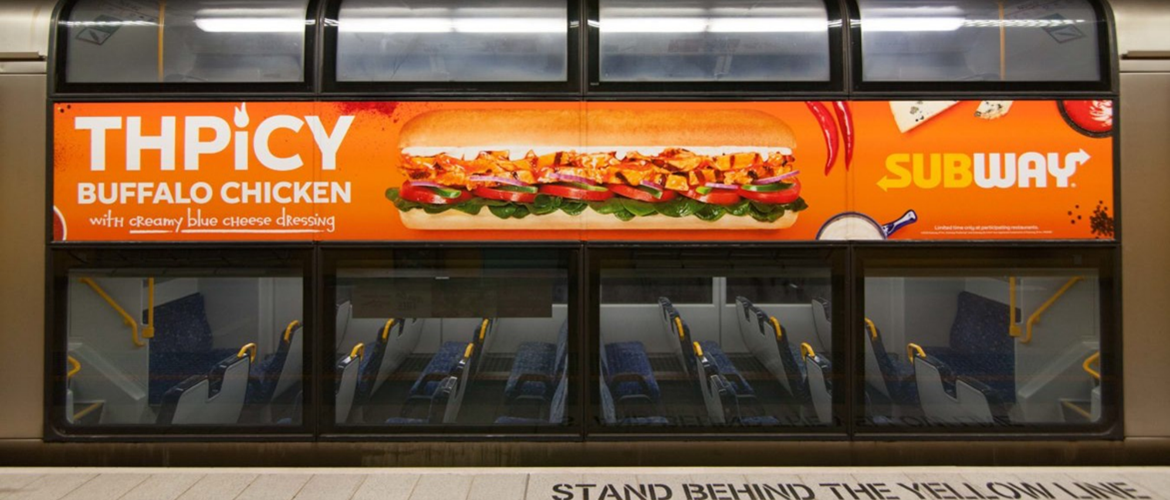
In a busy advertising landscape, brands need more than another message competing for attention on a screen. They need advertising that people notice naturally as they move through their everyday environment.
Train wrap advertising provides exactly that opportunity.
By transforming the exterior of a train into a large-scale branded canvas, businesses can turn an ordinary journey into a memorable brand experience. A well-designed train wrap can be seen by passengers, pedestrians, motorists, shoppers and people living or working along railway routes.
Unlike a conventional billboard that remains in one location, a branded train moves through multiple suburbs and high-traffic areas, taking the campaign with it.
For Australian brands looking to build awareness across urban markets, train wrap advertising can be a powerful part of an integrated outdoor advertising strategy.
What Is Train Wrap Advertising?
Train wrap advertising is a form of transit advertising where branding, graphics or promotional messages are applied to the exterior of a train.
Depending on the campaign and available media formats, advertisers may use:
- Full train wraps
- Partial train wraps
- Side-of-car branding
- Large exterior panels
- Door branding
- Window graphics
- Special creative executions
A full wrap can create an immersive visual experience across one or more carriages, while partial branding can deliver strong visibility without covering the entire train.
The objective is simple: make the train itself part of the advertising campaign.
Why Train Wrap Advertising Gets Attention
One of the biggest advantages of train wrap advertising is its physical presence.
People are surrounded by digital content every day. Online advertisements can be skipped, scrolled past or ignored. A large branded train, however, becomes part of the physical environment.
A moving train can attract attention from multiple audiences at the same time.
Passengers
Passengers experience the branding when they are inside the train or when branded trains arrive at stations.
Pedestrians
People walking near railway lines, stations and busy urban areas can see the exterior campaign.
Motorists
Where rail corridors run alongside major roads, drivers and passengers may see branded trains moving through the city.
Other Commuters
Trains can also be visible from platforms, station concourses and other trains.
This gives train wrap campaigns a broader audience than advertising that only reaches passengers inside a carriage.
A Train Becomes a Moving Billboard
One of the simplest ways to understand train wrap advertising is to think of the train as a mobile billboard.
A traditional billboard communicates from one fixed location.
A branded train can travel through multiple locations during its operating schedule.
This mobility creates an opportunity for brands to build visibility across a wider geographic area while maintaining a consistent visual identity.
The Australian Media Federation describes train wraps as a transport OOH format used for impact and reaching commuting audiences.
For brands focused on awareness, this combination of scale and movement can make train wraps particularly memorable.
The Key Benefits of Train Wrap Advertising
1. Large-Scale Brand Visibility
A train provides a substantial advertising surface.
Instead of placing a relatively small advertisement in one location, a campaign can use the exterior of an entire carriage or multiple carriages to create a much larger visual presence.
This gives advertisers room to use:
- Large brand imagery
- Product photography
- Strong brand colours
- Short campaign messages
- Creative storytelling
- Distinctive visual concepts
The larger format can help a brand stand out in busy urban environments.
2. Mobile Audience Reach
A train does not stay in one place.
As it travels through a network, the advertising campaign can be exposed to audiences across different stations, suburbs and surrounding areas.
This makes train advertising Australia an attractive option for businesses that want to build broad awareness within a metropolitan market.
3. Repeated Exposure
Commuters often follow similar routes on a regular basis.
A person may see the same branded train several times during their weekly journey.
Repeated exposure can help reinforce brand recognition and make a campaign more familiar over time.
For awareness campaigns, consistency and frequency can be just as important as a single high-impact impression.
4. Reaches More Than Train Passengers
Train advertising is not limited to people sitting inside the carriage.
Exterior campaigns can reach audiences outside the train environment, including people near railway stations, pedestrians, motorists and communities along rail corridors.
This makes train wraps different from conventional on-train advertising, which is primarily designed for passengers inside the carriage. S&J Media Group’s transit advertising formats include both interior and exterior train solutions.
5. Strong Creative Potential
A train offers a large canvas for creative advertising.
Rather than treating the train as a simple rectangular advertising space, designers can create artwork that works with the shape and movement of the vehicle.
A strong concept can:
- Continue across multiple carriages
- Use visual storytelling
- Create oversized product imagery
- Integrate brand colours
- Use minimal but memorable messaging
- Create visual connections between different sections of the train
The result can feel more like a branded experience than a conventional advertisement.
Full Train Wrap vs Partial Train Wrap
Not every campaign needs a complete train wrap.
Choosing between a full train wrap and a partial wrap depends on the campaign objective, creative concept and available media format.
Full Train Wrap
A full train wrap uses a much larger portion of the train exterior.
This format is particularly suitable for major brand campaigns, product launches and high-impact awareness campaigns.
A full wrap can create a strong visual statement because the entire vehicle becomes part of the creative.
Partial Train Wrap
A partial wrap uses selected areas of the train exterior.
This can still provide substantial visibility while allowing advertisers to focus the creative on specific parts of the vehicle.
Partial formats can work particularly well when the campaign concept does not require complete vehicle branding.
How to Design an Effective Train Wrap Campaign
Great train wrap advertising is not simply about putting a logo on a large surface.
The design needs to work in motion.
People may only have a few seconds to see the advertisement, so the creative must communicate quickly.
Keep the Main Message Simple
Avoid filling the train with long paragraphs.
A strong train campaign should usually communicate its key message through a combination of:
Brand + Visual + Short Message + Call to Action
The audience should understand the main idea quickly.
Use Strong Visual Hierarchy
The most important elements should be immediately visible.
For example:
- Main visual
- Brand name or logo
- Key message
- Supporting information
- CTA
Trying to give every element equal visual importance can make the campaign difficult to understand.
Use Large, Readable Typography
Train advertisements are viewed from different distances and angles.
Small text may disappear when the train is moving.
Large typography and strong contrast can make the message easier to recognise.
Design for Movement
A train is not a static billboard.
The artwork needs to remain effective when the vehicle is:
- Moving quickly
- Passing a platform
- Viewed from an angle
- Partially obstructed
- Seen from another train
- Viewed from a nearby road
Strong shapes and simple compositions generally work better than overly complicated layouts.
Using QR Codes on Train Advertising
QR codes can connect physical advertising with digital campaigns.
A passenger or passerby who is interested in the advertisement can scan the code and continue the customer journey online.
A QR code could lead to:
- A product page
- A promotional offer
- A campaign landing page
- An event registration page
- An app download
- A social media profile
However, the QR code should not replace the main advertising message.
The campaign should still communicate its key idea even if someone never scans the code.
Train Wrap Advertising for Different Industries
A wide range of businesses can use train wrap campaigns to build brand awareness.
Retail Brands
Retailers can use large-scale train branding to promote new products, seasonal campaigns or major store launches.
Tourism
Tourism brands can use large destination imagery to inspire people and create awareness of travel experiences.
Entertainment
Movies, streaming platforms, concerts and events can use train wraps to create attention around launches and major releases.
Technology
Technology companies can use bold visual concepts to introduce new products, services or digital platforms.
Education
Universities, colleges and training organisations can use transit advertising to reach students and young professionals.
Financial Services
Banks, insurance companies and financial brands can use train advertising to strengthen brand recognition among commuters.
Government and Public Awareness
Government departments and organisations can use large train campaigns for public information and awareness initiatives.
Train Wrap Advertising in Australia
Australia’s major metropolitan rail networks provide advertisers with opportunities to connect with large urban and suburban audiences.
S&J Media Group’s transit advertising solutions cover train advertising across markets including New South Wales, Victoria and Queensland. The company’s network information highlights substantial commuter activity across Sydney, Melbourne and South East Queensland.
This makes train wrap advertising Australia particularly relevant for campaigns seeking physical visibility in major population centres.
The right network, route and format should always be selected according to the target audience and campaign objectives.
Train Advertising vs Traditional Billboards
Both train advertising and billboards can play an important role in an outdoor advertising campaign, but they offer different advantages.
| Feature | Train Wrap Advertising | Traditional Billboard |
|---|---|---|
| Mobility | Moves across multiple locations | Fixed location |
| Creative Surface | Large vehicle exterior | Fixed advertising panel |
| Audience | Passengers and external audiences | People passing the location |
| Frequency | Can be seen repeatedly along routes | Depends on location and traffic |
| Visual Impact | Large moving branded object | Large static display |
| Geographic Reach | Can cover multiple areas | Concentrated around one location |
The best option depends on the campaign.
For brands seeking a strong physical presence across a transport network, train wraps can provide a distinctive alternative to traditional outdoor advertising.
Integrating Train Wrap Advertising With Digital Marketing
Train advertising does not need to operate independently.
In fact, it can become more powerful when integrated with digital channels.
A campaign might follow a journey such as:
Train Wrap → Search → Website → Social Media → Conversion
Someone sees a branded train during their commute.
Later, they search for the brand online.
They visit the website, interact with social media content and eventually become a customer.
This is why train advertising can work particularly well as part of a wider integrated advertising campaign.
The physical advertisement creates awareness, while digital channels provide the information and conversion opportunities that follow.
How to Measure a Train Wrap Campaign
Outdoor advertising is often associated with brand awareness, but advertisers can still use several methods to evaluate campaign performance.
Brand Search
Monitor changes in branded search activity during and after the campaign.
Website Traffic
Analyse website visits and landing-page traffic during the campaign period.
QR Code Scans
Use a campaign-specific QR code to track direct interactions.
Social Engagement
Monitor mentions, campaign hashtags and social media engagement.
Lead Generation
If the campaign includes a dedicated landing page or offer, track enquiries and conversions.
Brand Awareness
Surveys and customer research can help measure changes in awareness and recognition.
A strong measurement strategy should be established before the campaign begins.
How to Make a Train Wrap Campaign More Memorable
The most successful train advertising campaigns usually have a simple idea that can be understood quickly.
Consider creating a concept based around:
- A striking visual
- Oversized product imagery
- Clever use of the train shape
- A memorable slogan
- Strong brand colours
- Humour
- A surprising visual idea
- A simple interactive element
The goal is not to communicate everything.
The goal is to make people remember something.
Why Train Wrap Advertising Can Strengthen Brand Awareness
Modern consumers encounter advertising across dozens of channels every day.
A physical branded train can provide something different: scale, movement and presence.
It becomes part of the city environment.
When a campaign is visually distinctive and repeated across a commuter’s routine, it can strengthen recognition and help a brand remain top-of-mind.
For businesses competing in crowded markets, this physical visibility can complement digital advertising and other outdoor media channels.
The Future of Train Wrap Advertising
Train advertising is continuing to evolve alongside the wider Out of Home advertising industry.
Digital technology, audience measurement, data and integrated campaigns are creating new ways for brands to connect physical advertising with digital experiences.
At the same time, the fundamental advantage of a train wrap remains unchanged:
It is difficult to ignore a large, moving brand message travelling through the city.
As advertisers look for ways to balance digital campaigns with high-impact physical media, train wraps can continue to play an important role in the modern Out of Home advertising mix.
Conclusion
Train wrap advertising turns public transport into a large-scale moving brand experience.
Its combination of size, mobility, repeated exposure and creative flexibility allows brands to reach audiences both inside and outside the train environment.
From retail and tourism to entertainment, education, technology and public awareness campaigns, train wraps can be adapted to a wide range of marketing objectives.
The strongest campaigns are not simply large.
They are clear, creative and memorable.
With the right design, route strategy and digital integration, a branded train can become far more than an advertisement.
It can become a moving part of the city that people notice, remember and associate with your brand.
Frequently Asked Questions About Train Wrap Advertising
What is train wrap advertising?
Train wrap advertising is a form of transit advertising where branding and promotional graphics are applied to the exterior of a train. Depending on the available format, campaigns can use full or partial wraps and other exterior branding options.
What is a full train wrap?
A full train wrap covers a substantial portion of the train exterior with a coordinated advertising design. It can transform the train into a large moving billboard and is often used for high-impact brand campaigns.
Who sees train wrap advertising?
Train wraps can be seen by passengers, pedestrians, motorists, commuters waiting at stations and people living or working near railway routes.
Is train wrap advertising effective for brand awareness?
Train wraps can be particularly useful for brand awareness because of their large visual presence, movement and potential for repeated exposure across commuter routes.
What should I include in a train wrap design?
A strong train wrap should generally include a clear brand identity, a strong visual concept, concise messaging and an easy-to-understand call to action.
Can train advertising include QR codes?
Yes. Where the advertising format permits, QR codes can connect viewers to websites, promotions, landing pages, social media or other digital experiences.
What is the difference between train wrap advertising and on-train advertising?
Train wrap advertising primarily uses the exterior of the train, while on-train advertising generally refers to advertising inside the carriage. S&J Media Group offers both interior and exterior transit advertising formats.
Is train wrap advertising available in Australia?
Train advertising formats are available across major Australian metropolitan markets, with options depending on the transport network, available inventory and campaign requirements. S&J Media Group provides train advertising solutions across markets including NSW, Victoria and Queensland.
GET IN TOUCH WITH OUR TEAM

Melbourne
Head Office
Level 7, 492 St Kilda Road,
Melbourne Vic 3004
Ph: 03 9867 1022
info@sjmediagroup.com.au

Sydney
Office
Level 3, WeWork c/o S&J Media Group,
100 Harris Street,Pyrmont NSW 2009
Ph: 02 8424 6100
info@sjmediagroup.com.au

Brisbane
Office
WeWork c/o S&J Media Group,
310 Edward St,Brisbane City QLD 4000
Ph: 07 3217 2233
info@sjmediagroup.com.au